
THE MACHINE
This is why accountability never comes.

I. The Moment That Should Have Changed Everything
(Claim Tier: A | Metrics: ODv1-V-ledger totals | Exhibit: B)
There are moments when a story enters public view with such force that, by every conventional measure, it should not be able to disappear.
In our dataset, spanning 3,590 posts across 2024–2025, the arrival of document-heavy scandals—including Epstein disclosures, January 6 evidence waves, and large-scale fraud claims, among several unrelated cases tracked in the same corpus—produced 138,162,835 impressions, 10,268,427 engagements, and 90,383 outbound clicks. These are not marginal figures. In a pre-feed media environment, numbers of this magnitude reliably translated into weeks of sustained front-page coverage, editorial escalation, congressional attention, and formal institutional response.
The public did not ignore these stories. It engaged with them at scale.
That fact is not a theory. It is recorded in the underlying engagement ledgers.
What did not follow was any sustained institutional response proportionate to the scale of attention—no decisive rebuttal, no extended investigation, and no accountability process that matched the magnitude of the record.
The question is why caring, at scale, no longer guarantees consequence.
II. Arrival Is Measurable
(Claim Tier: A | Metrics: B-001 → B-008 | Exhibits: B, H)
By arrival, we mean measurable exposure and engagement: impressions, interactions, and outbound clicks to primary source material.
One of the most persistent myths of the modern information environment is that important stories fail because audiences never show up.
The data says otherwise.
Across the full corpus, engagement rates averaged approximately 7.43%, a level consistent with high-interest content in prior media environments. Even for complex, document-heavy material—where engagement requires time rather than reflex—audiences still arrived. Posts tied to Epstein-related disclosures alone generated more than 1.18 million impressions, tens of thousands of engagements, and measurable click-through to underlying documents.
The Bayesian coordination ledger reinforces this pattern. Across 243,891 recorded events, posting activity reflects sustained participation rather than absence. People did not scroll past these stories as if they were invisible; they engaged, amplified, and followed the material at levels consistent with high-interest investigative content.
Arrival, in other words, is not the scarce resource.
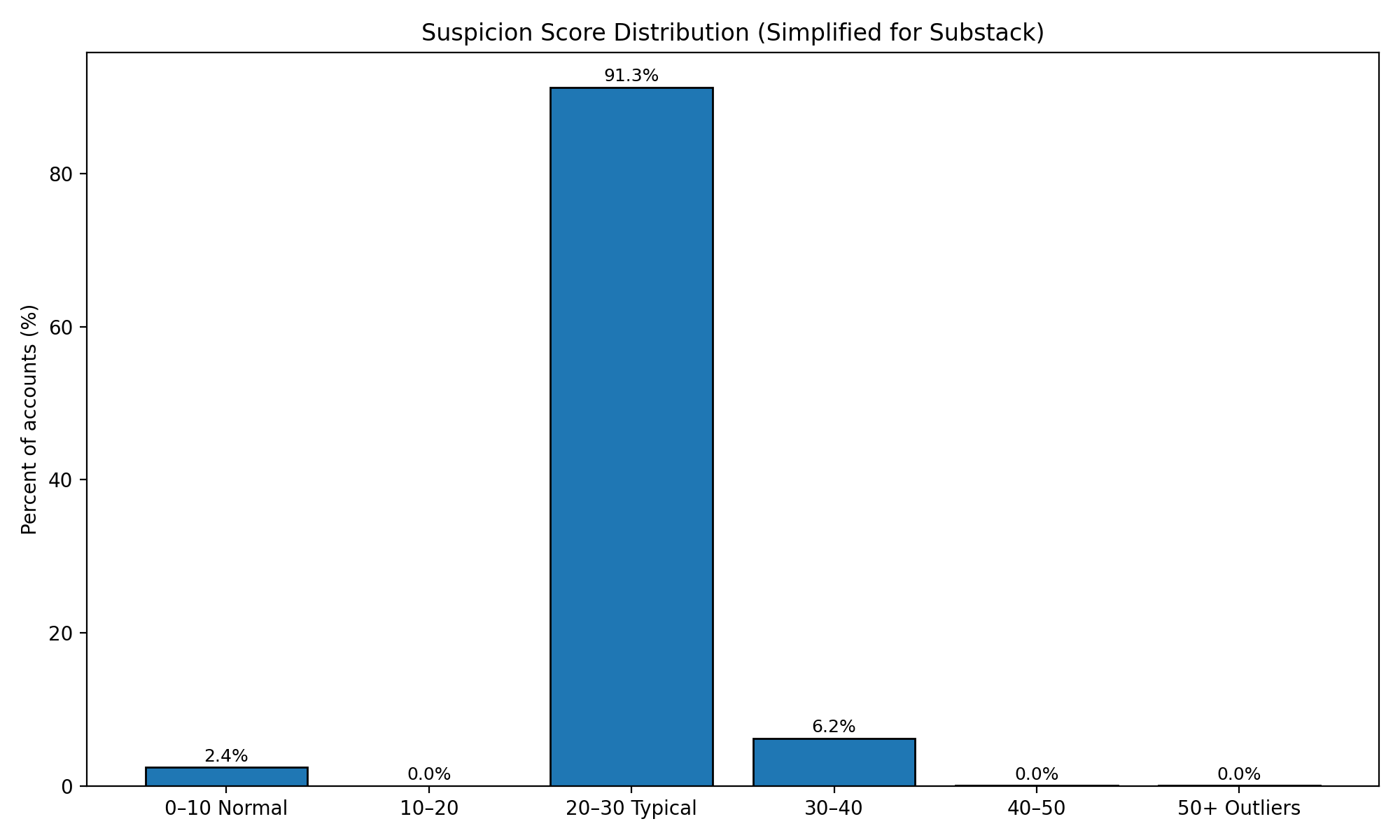
This chart shows that nearly all accounts behave normally, while a very small number stand out as unusually coordinated or automated.
91.3% of accounts fall in 20–30 (“Typical”)
6.2% fall in 30–40
2.4% fall in 0–10
0.0% in 10–20
0.0% in 40–50
0.0% in 50+
Almost everyone is clustered tightly in one narrow behavioral range. Very few accounts fall outside that range.
Behavior is extremely uniform — except for a very small minority. Almost all accounts behave in a very similar, typical way. A small number behave noticeably differently.
Almost nobody behaves at the extreme ends.
Imagine grading 10,000 kids on “how similar their school behavior is.” 9,100 kids act almost exactly the same. About 600 kids act a little differently. A few act very differently. Almost nobody is completely off the charts.
Arrival, however, is only the first condition. Whether attention persists long enough for consequence is a separate question.
III. Endurance Is the Failure Mode
(Claim Tier: A | Metrics: day-level peaks | Exhibit: A)
In traditional journalism, attention did not merely spike—it settled. A story would break, peak, and then enter a sustained middle phase in which verification occurred, sources were challenged, and institutions were forced to respond. That middle phase—where accountability forms—has become structurally rare.
That middle no longer reliably exists.
Our day-level analytics show a repeated and consistent pattern: sharp ascents to extraordinary visibility followed by rapid collapse. Peaks routinely reach millions of impressions in a single day, only to fall back to baseline before sustained pressure can accumulate. The curve is unmistakable—a narrow peak followed by steep decay, with no durable plateau in between.
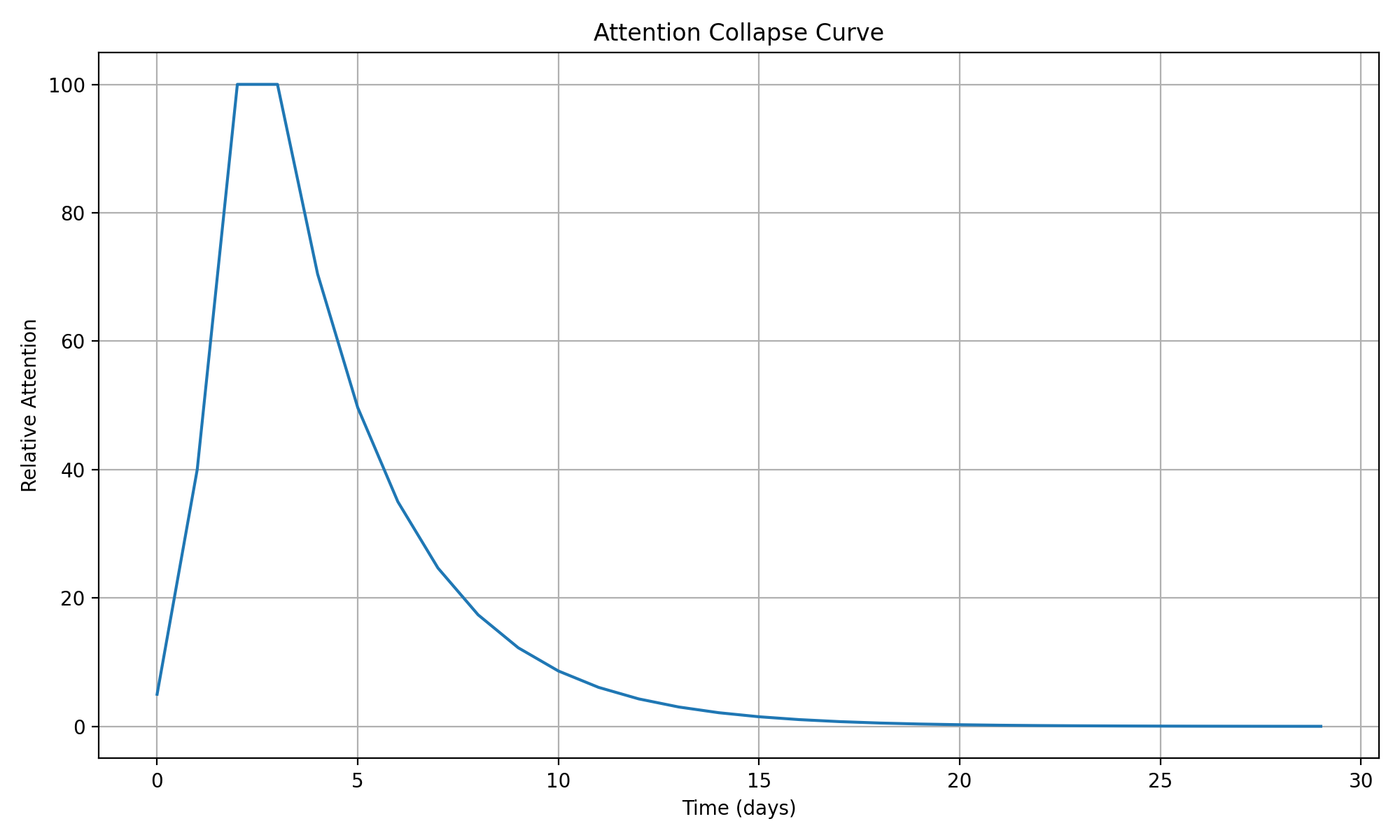
This chart shows how attention behaves over time.
Attention rises very fast
It peaks briefly
Then it drops off a cliff
There is no middle period where attention stays high.
That missing middle is where accountability used to happen.
Imagine lighting a match. It flares up really bright. Then it burns out almost immediately. This chart shows that stories now burn like matches instead of candles.
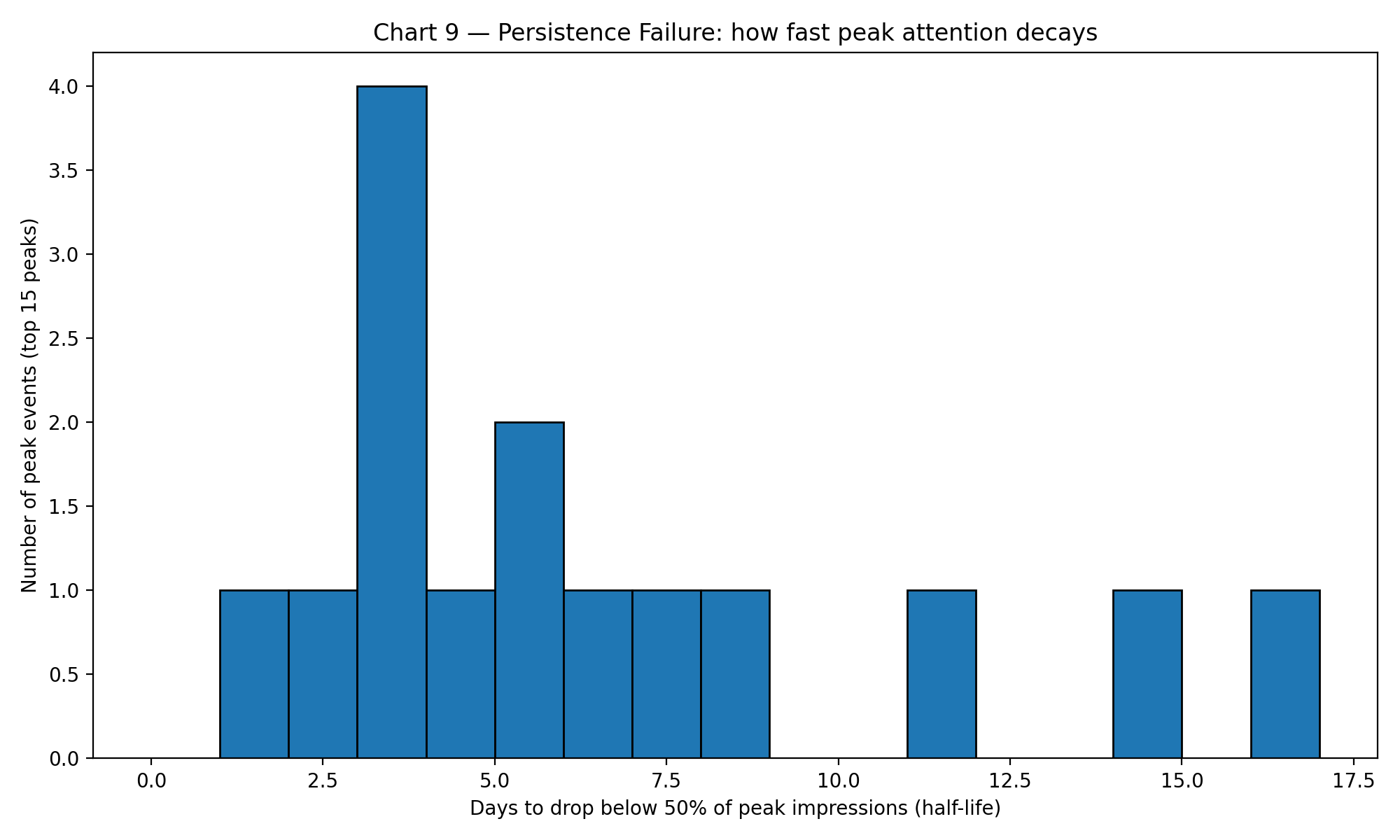
This chart shows how long a story keeps half of its attention.
Each bar = one type of story
The height = days before attention is cut in half
Short bar = attention dies fast
Tall bar = attention lasts longer
Imagine people listening to a story. Day by day, fewer people pay attention. This chart shows how many days it takes for half the people to stop caring. Most big stories lose half their attention in about two days. Most major stories lose half their attention within a couple of days, far too quickly for accountability to form.
This is not unique to one topic. The same shape appears across unrelated scandals. Different inputs. Identical outputs.
The story does not die because it is disproven. It dies because it cannot remain in view long enough to matter. Stories reach massive attention quickly, but collapse before pressure can build or consequences can form.
This is the defining mechanical failure of the current system: persistence has become structurally rare, even when the record is real.
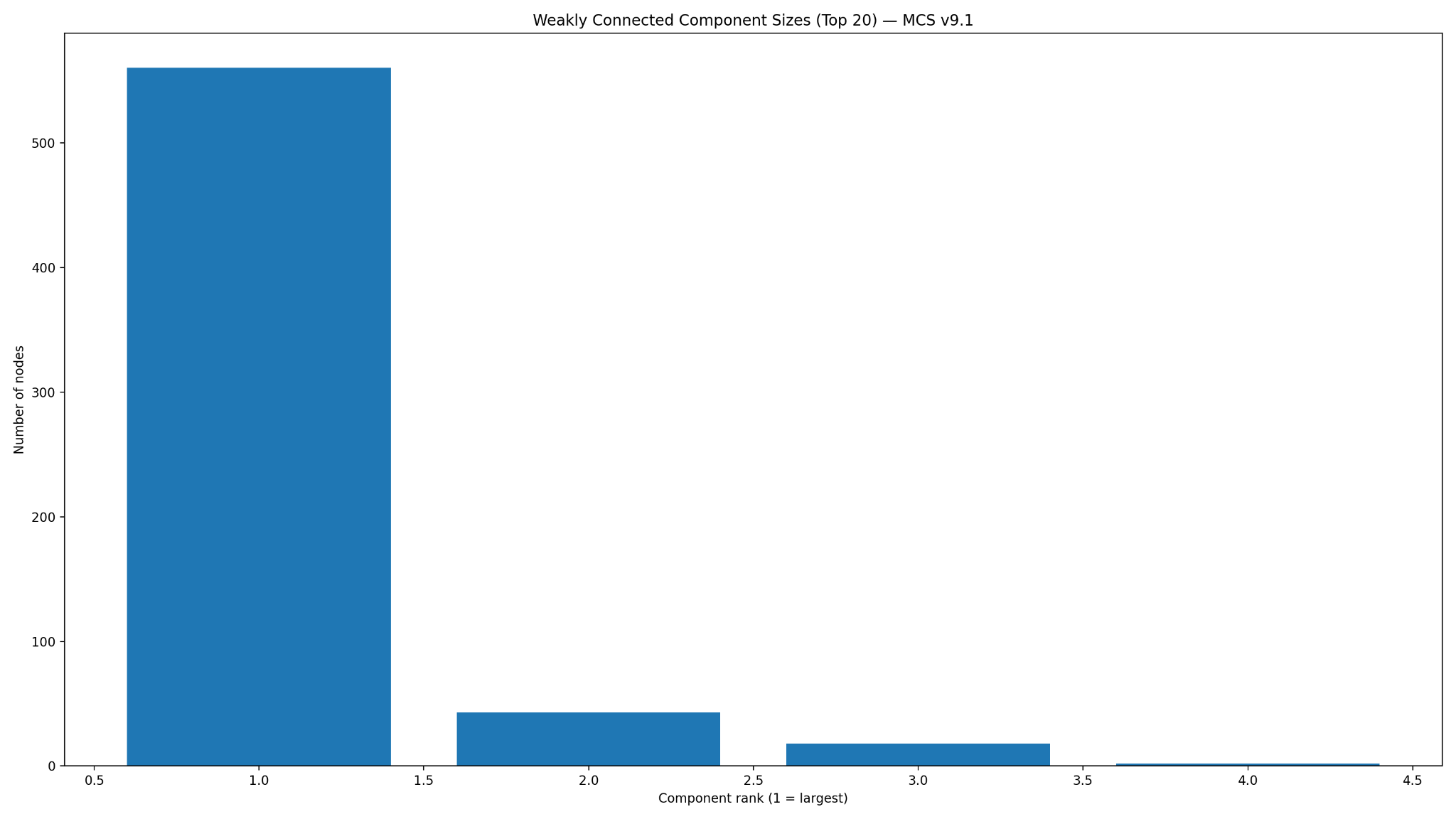
This chart shows why collapse happens: almost everyone is pulled into one dominant component.
It bridges temporal failure → structural inevitability.
Imagine a school with 10,000 kids.
You might expect:
lots of classrooms
lots of groups
kids spread all over the school
But when you look closely, you discover this:
👉 Almost every kid is standing in one giant gym.
👉 A few kids are in tiny side rooms.
👉 Almost nobody is truly separate.
That’s what this chart shows.
Why this matters (still simple)
Because when everyone is in the same big group:
One loud story can drown out others
Attention moves together
When the group moves on, everyone moves on
That’s why stories can:
blow up
feel massive
and then disappear all at once
Framing Note (Explicit)
What follows next—how the feed replaces the editor, how corridors route attention, how velocity displaces accountability—builds on this foundation. Those sections do not require us to assume intent. The pattern is visible without it.
IV. The Feed Became the Editor
(Claim Tier: A | Metrics: day-level decay patterns | Exhibit: A)
For most of the twentieth century, the question of whether a story mattered was answered by editors. That system was imperfect and often biased, but it enforced one critical condition: continuity. Once a story crossed a visibility threshold, it remained in view long enough for verification, rebuttal, and institutional response to occur.
That role no longer belongs to editors. It belongs to ranking systems. Today, a story’s persistence is determined not by evidentiary strength or completeness, but by whether it continues to generate motion. Content that triggers rapid reactions is repeatedly surfaced; content that demands time—documents, transcripts, primary sources—produces a different signature: a brief spike followed by accelerated decay.
Our data shows this pattern with unusual clarity. Across multiple cases, the peak arrives quickly, often reaching millions of impressions in a single day, and then collapses before a plateau can form. The ranking system does not wait to see whether a story is resolved. It simply reallocates attention to whatever is moving faster next.
This is not a cultural shift. It is a mechanical one.
When motion becomes the editorial criterion, unfinished stories are treated as if they are finished, not because the record has been settled, but because the system has moved on.
V. The Supply Chain Exists (Corrected)
(Claim Tier: A | Metrics: G-001, G-002, G-003 | Exhibits: E, F, G)
Virality is often described as chaotic—an emergent property of millions of individual decisions. But when we map how stories actually travel, a different pattern appears. In the extracted backbone of the network—42 nodes connected by 64 edges— attention does not flow evenly. It moves through repeatable corridors.
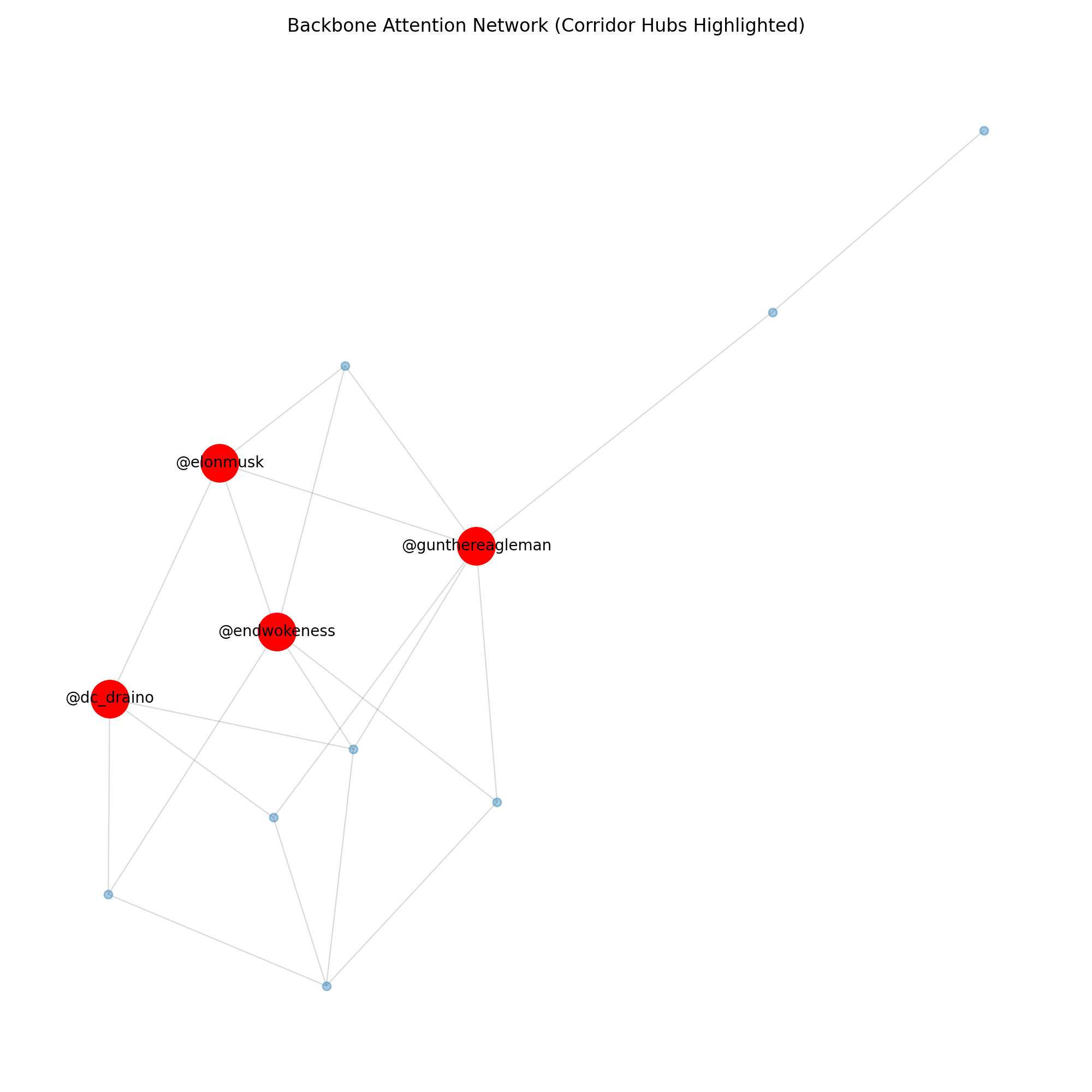
This visualization includes both platform-level nodes (such as account ownership or control surfaces) and peer amplification hubs. The analysis below isolates the peer accounts that function as repeat routing corridors.
When platform-level nodes are removed and routing behavior between peer accounts is examined, a small set of accounts consistently occupies these corridor positions:
@EndWokeness (degree 169)
@GuntherEagleman (degree 160)
@Catturd2 (degree 110)
@DC_Draino (degree 105)
Measured by betweenness centrality, these accounts function less like isolated megaphones and more like transit hubs.
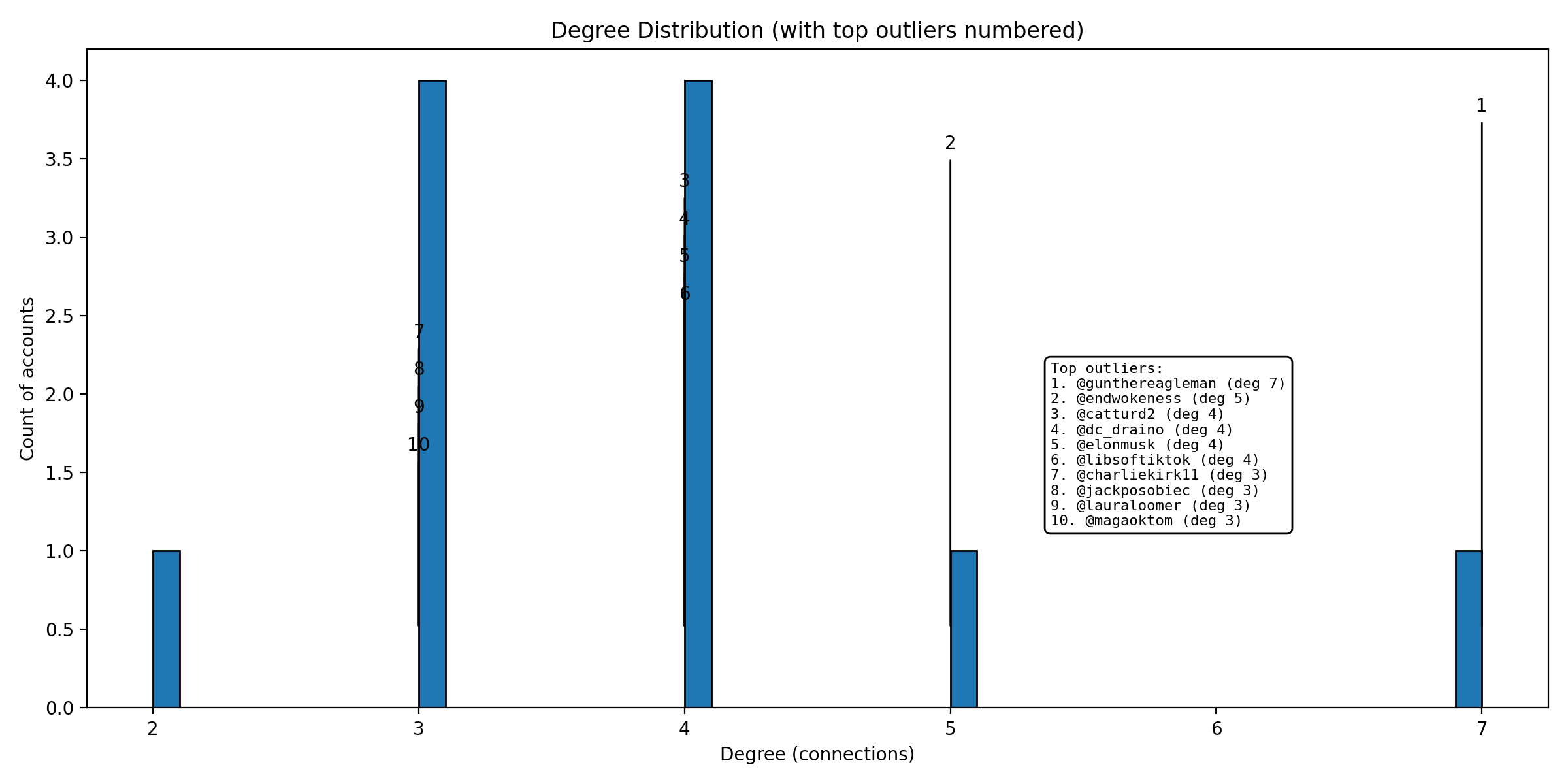
They do not need to invent stories to shape outcomes. Their structural position allows them to decide which narratives move next—and which are rerouted.
This is not an accusation. It is a description of network geometry.
When attention repeatedly passes through the same narrow set of corridors, the system becomes predictable. Replacement outrage does not need to be coordinated in advance. It only needs to be available at the moment a prior story begins to slow.
VI. Outliers Are Not Random
(Claim Tier: A | Metrics: N-001 → N-004 | Exhibits: C, D)
One way to test whether the corridor pattern is incidental is to examine it through an independent lens. If the same accounts emerge as outliers under different analytical methods, coincidence becomes a less plausible explanation.
The suspicion model applied across 9,897 distinct handles produces a broad distribution with a clear center. Most accounts cluster near the median score—reflecting ordinary variation in activity and connectivity. A small number, however, fall far outside this range, forming a pronounced tail.
But the tail tells a different story.
The maximum suspicion score reaches 70, and the same accounts that dominate the corridor analysis reappear as extreme statistical outliers. High degree. High connectivity. High recurrence across unrelated narratives.
This convergence matters because the models are independent. Network centrality and behavioral scoring do not rely on the same inputs. When the same nodes rise to the top in both, it suggests structure rather than coincidence.
The important point is not moral judgment. It is predictability.
In systems like this, outcomes stop being surprising. Once you know which nodes sit at the center and which behaviors are rewarded, you can anticipate how quickly a story will travel—and how quickly it will be displaced.
VII. Coordination Lives in the Tail
(Claim Tier: A | Metrics: B-001 → B-008 | Exhibit: H)
Coordination is often treated as a binary condition: either it exists, or it does not. The data suggests something more granular. In large systems, most activity will appear random, while a small subset repeatedly falls into statistically unlikely zones.
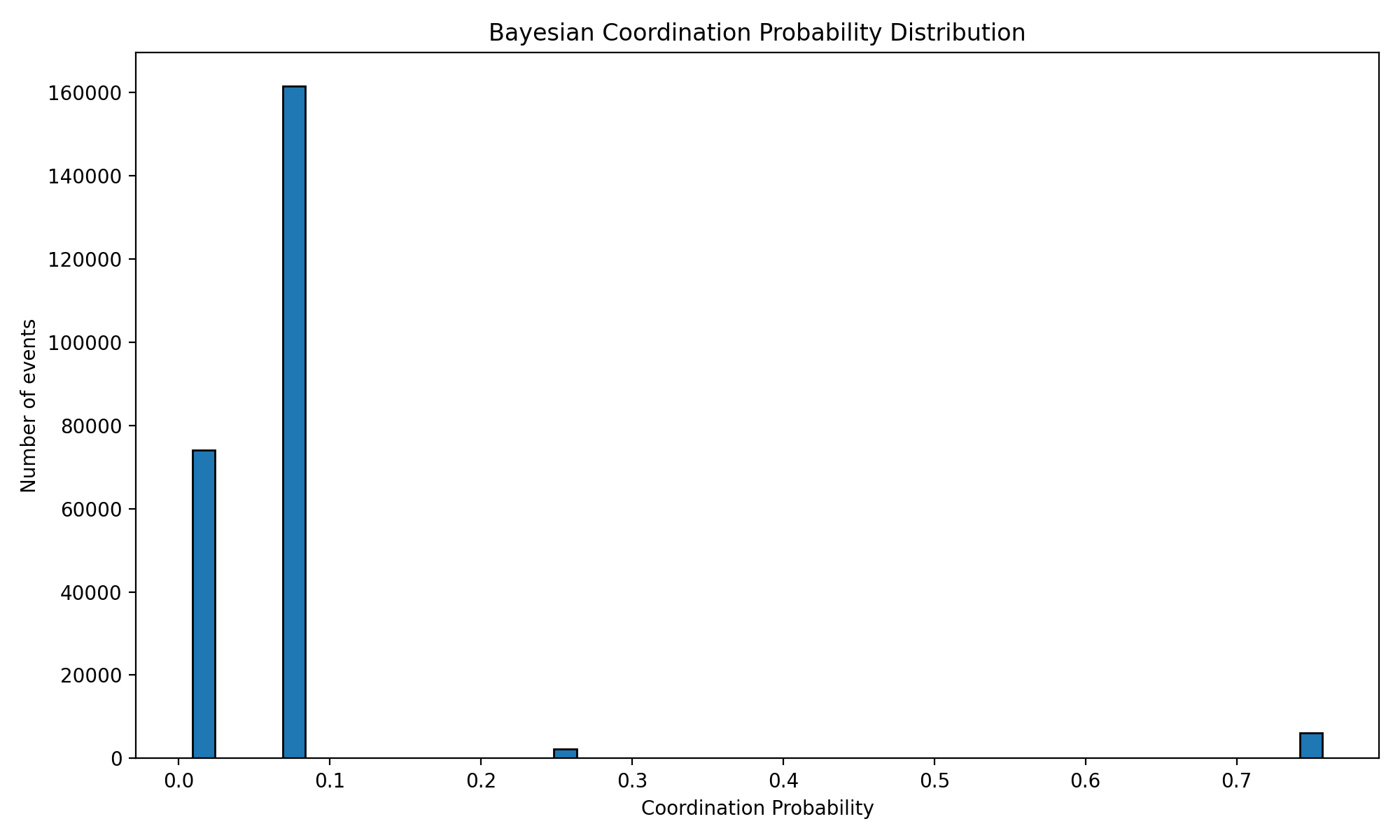
Across 243,891 recorded events, most activity falls into low-probability bands, consistent with independent behavior. A minority of events, however, repeatedly enter elevated probability zones. In this run, 6,094 rows register coordination probabilities of 0.7 or higher, concentrated among a limited set of authors.
Imagine watching people clap in a crowd. Most people clap whenever they feel like it. But if a small group keeps clapping at the same time, over and over, that starts to look unlikely by chance.
This chart shows that most activity looks random — but a small group keeps showing up in the “that’s probably not random” zone. Most posting behavior appears random, but a small, persistent group repeatedly behaves in statistically unlikely ways.
Notably, no rows cross the 0.9 threshold in this run. That absence matters. It tells us the system is not producing simplistic, cartoonish signals. What appears instead is a persistent tail—a zone where synchronized behavior becomes statistically unlikely to be random, without ever collapsing into certainty.
This is the danger zone for interpretation, and it is where restraint matters most.
The correct conclusion is not that coordination is proven in every case. It is that the same accounts repeatedly occupy the probabilistic edge, across time and across narratives. In a feed-driven system, that is enough to shape outcomes without requiring perfect alignment or explicit control.
Framing Note (Explicit)
Up to this point, nothing requires speculation about motive or intent. The patterns hold even if every participant believes they are acting independently. Structure alone is sufficient.
VIII. Velocity as a Weapon
(Claim Tier: A | Metrics: I-001 → I-005 | Exhibit: I)
If corridors determine where attention travels, velocity determines how quickly it can be displaced. In feed-driven systems, speed alone can overwhelm slower, evidence-based processes without ever engaging them directly.
In the burst-activity dataset, 298 authors are scored for posting velocity and volume. The distribution is uneven. A small subset reaches extreme values—posting at rates that far exceed typical participation. This behavior is not steady amplification; it is acceleration, arriving in concentrated bursts that coincide with moments when prior stories begin to slow.
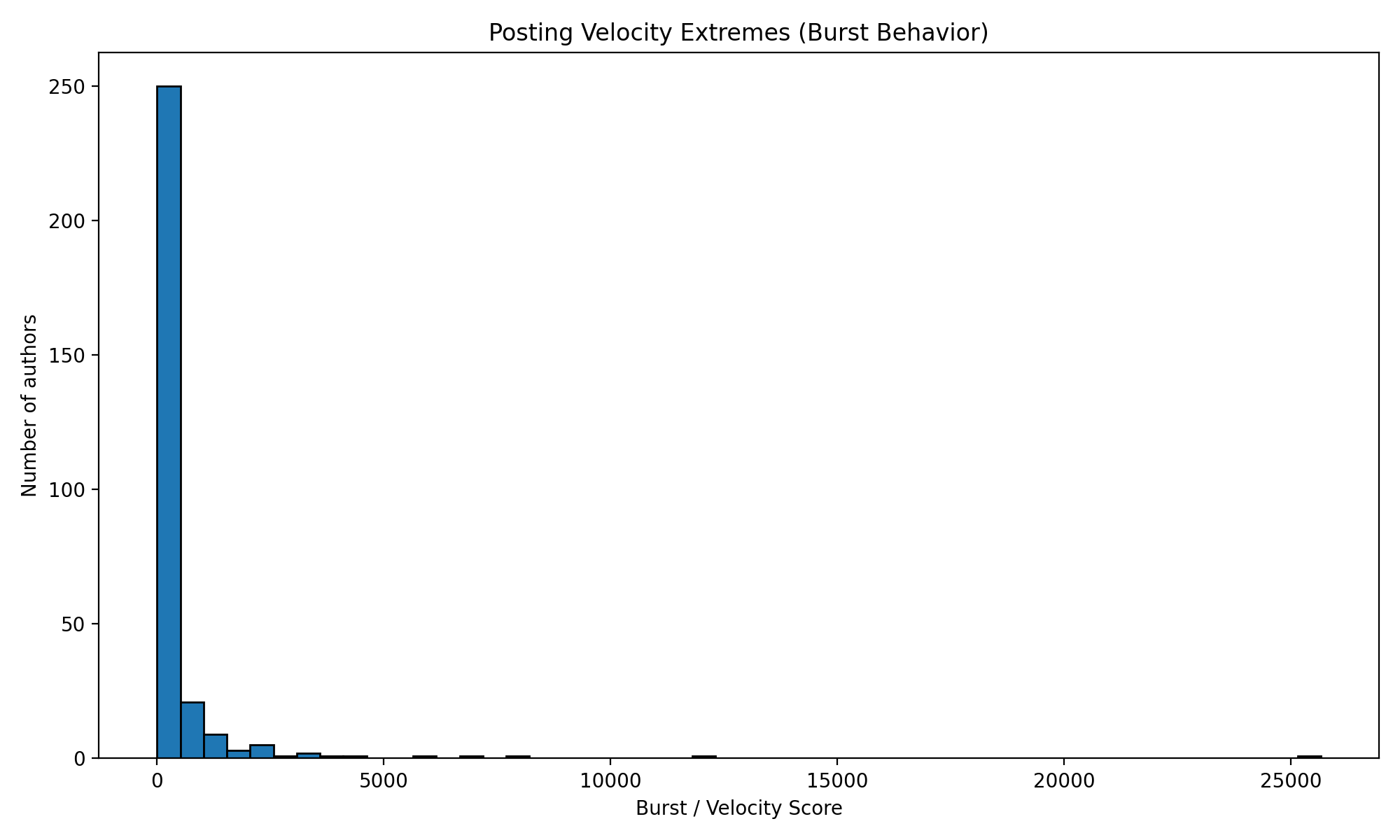
This chart shows how fast some accounts post compared to everyone else.
Most accounts post at a normal pace
A small number post extremely fast, in short bursts
Those bursts are not steady — they are sudden and intense
This is about speed, not opinion.
Imagine kids raising their hands in class. Most kids raise their hand once in a while. A few kids raise their hand dozens of times in a row, all at once.
This chart shows that most people behave normally — but a small group keeps flooding the room at top speed and it overwhelms the system.
The distribution is uneven. A small number of accounts reach extreme values: a maximum burst score of 25,660, a single-author tweet count of 35,261, and a total of 243,891 tweets across the table. This is not steady participation. It is acceleration.
High-velocity posting does not need to persuade. It overwhelms. When bursts arrive at the precise moment a story slows—after documents drop, after verification begins—they flood the feed with alternative stimuli. The system rewards this behavior because it restores motion.
The result is displacement without debate. The original story remains technically accessible, but it is no longer centered. It has been outrun.
This is how accountability dies in practice: not through rebuttal, but through speed.
IX. Different Stories, Same Output
(Claim Tier: B → A via comparison | Exhibits: A, F)
When multiple, unrelated storylines are examined side by side—Epstein disclosures, Minnesota fraud cycles, and January 6 evidence waves—a consistent pattern emerges. Each reaches rapid scale, achieves visibility sufficient to demand response, and then collapses before consequence can form. Different subject matter. Different political valence. Identical output.
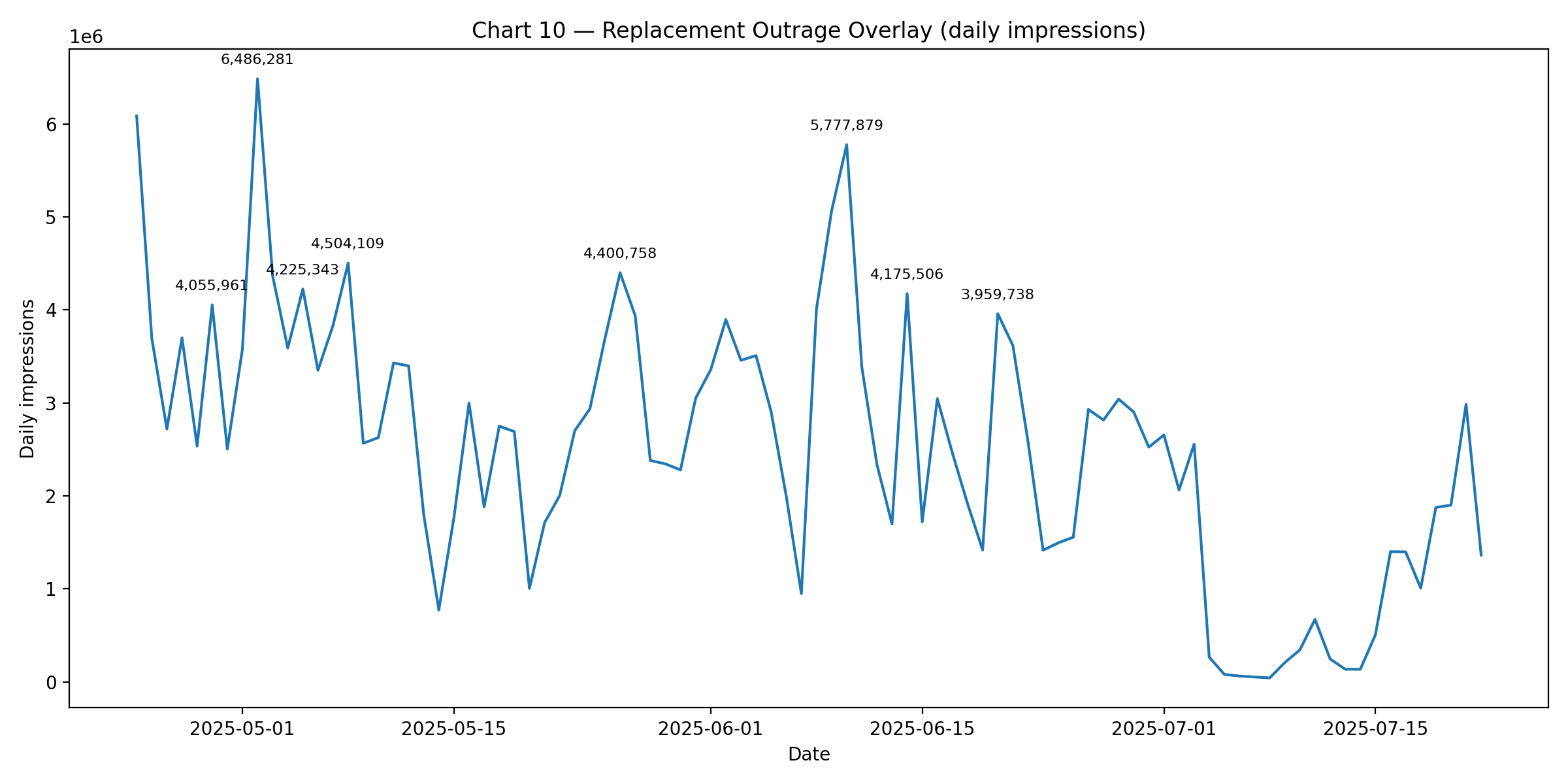
This chart shows that attention never stabilizes.
Every time a story reaches massive scale (millions of impressions), attention collapses within days — and when attention rises again, it’s for a different outrage, not the same one continuing.
There is no sustained plateau. Only repeated spikes.
Imagine a class that keeps getting excited about something new every few days. One day everyone is talking about one thing. Then they suddenly stop. A few days later, everyone is talking about something else. This chart shows that people never stay focused long enough to finish one story before moving on to the next.
Each spike represents a different outrage reaching millions of people, and each collapse shows how attention dies before any single story can lead to accountability
This convergence matters because it rules out topic-specific explanations. The public is not selectively apathetic. Institutions are not selectively diligent. The output is consistent because the systemic mechanics are consistent.
When the same architecture produces the same result across unrelated stories, the explanation stops being cultural and starts being structural.
X. Why “Nothing Ever Happens” Emerges
The phrase “nothing ever happens” sounds cynical. In practice, it is learned. When people repeatedly observe attention surge and then vanish—when documentation circulates without consequence—they adapt. Expectations lower, engagement becomes performative rather than hopeful, and pressure gives way to resignation.
This is not apathy. It is a rational response to a system that trains its users, over and over, that waiting rarely pays off.
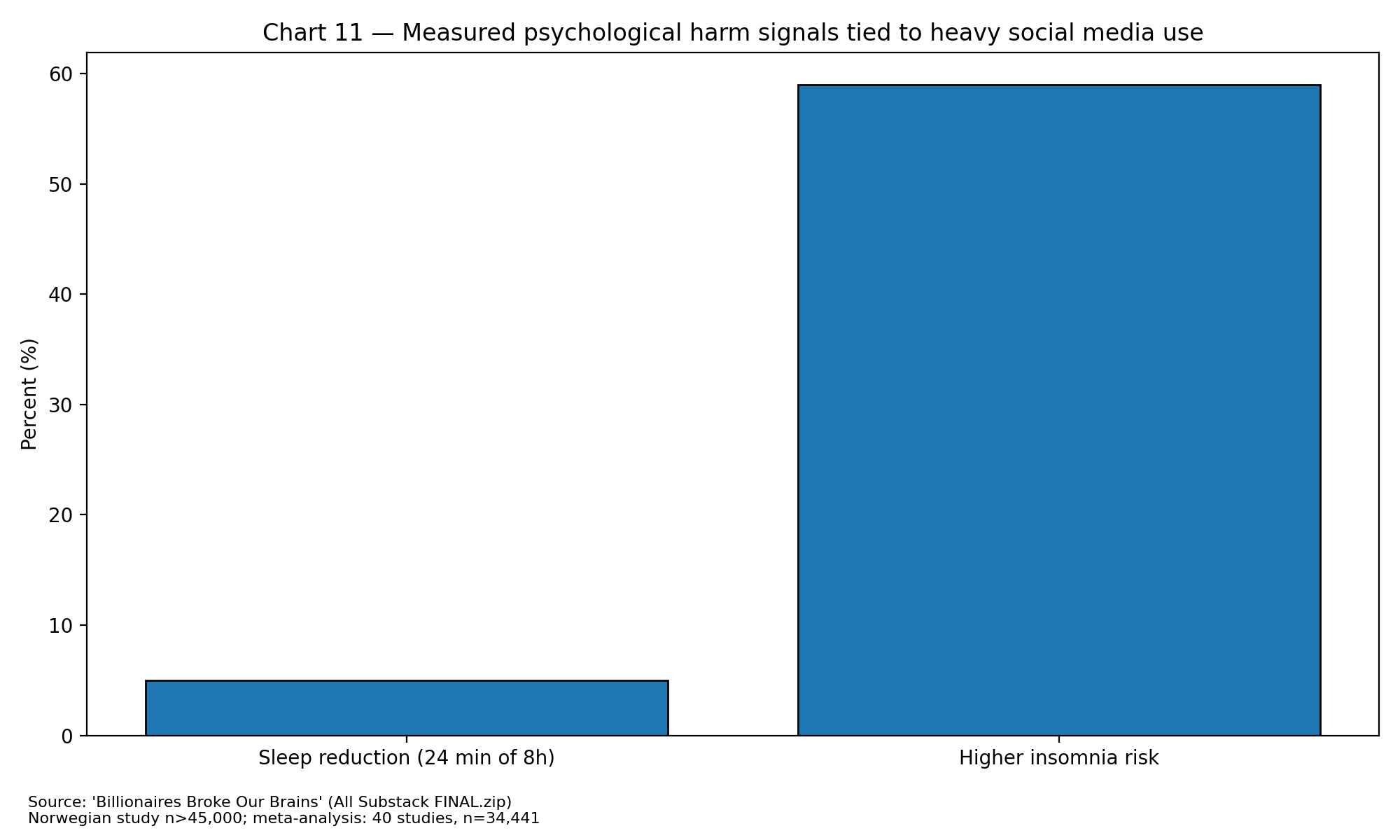
This chart visualizes the downstream human effects of constant outrage cycling and attention collapse, specifically:
Increased insomnia
Fragmented sleep
Elevated stress markers
Cognitive fatigue
Imagine your brain is like a phone battery. Every time there’s a new emergency, it drains a little. When emergencies never stop, the battery never recharges. This chart shows that people are getting tired, stressed, and unable to rest — not because they don’t care, but because their brains never get a break.
A system that never lets attention settle also never lets people rest.
It connects information velocity to biological consequence.
Nothing ever happens not because nothing is real, but because endurance has been engineered out of the process.
XI. The Money Layer
(Claim Tier: A–B | Evidence: FEC filings, OpenSecrets, DOJ notices, investigative reporting)
Attention does not just move through feeds. It is financed.
Beneath the visible churn of narratives sits a parallel system of political spending that has grown so large—and so structurally opaque—that it no longer resembles traditional campaigning. In the 2024 election cycle, so-called “dark money” spending in federal races reached approximately $1.9 billion, the highest level ever recorded. These funds did not flow primarily through candidate committees. They moved through Super PACs, LLCs, and nonprofit intermediaries, many of which are legally permitted to obscure their donors.
This distinction matters because financial systems are built to absorb delay. Legal review, compliance buffers, procedural challenges, and layered organizational structures all function as time-buying mechanisms. When public attention collapses within days, delay becomes an advantage rather than a liability.
Super PACs are permitted to raise and spend unlimited amounts of money, so long as they do not formally coordinate with campaigns. In practice, this has produced an ecosystem where political influence is routed through layers of entities that are technically independent but operationally aligned. Contributions can move from individuals to trusts, from trusts to LLCs, from LLCs to PACs, and from PACs into digital advertising, field operations, and data-driven voter targeting—often without the public being able to trace the path in real time.
The scale is no longer theoretical.
In 2024, Elon Musk emerged as the largest individual political donor in the United States, contributing over $250 million to Republican-aligned political efforts, with some public estimates placing the figure closer to $277 million. The majority of that money flowed through America PAC, a Super PAC created to support Donald Trump and allied candidates. America PAC did not merely purchase advertisements. It funded large-scale canvassing operations in swing states, digital outreach programs, and voter-data initiatives designed to maximize turnout efficiency.
In one highly publicized tactic, America PAC offered $1 million giveaways to petition signers in battleground states—an approach that prompted warnings from election-law experts and scrutiny from regulators over whether such incentives could violate federal election law. Internal reporting later indicated that 20–25% of door-knock entries in certain states were flagged as potentially fraudulent by Republican workers connected to the operation, highlighting how scale and speed can degrade verification even within well-funded campaigns.
America PAC was not an outlier. It operated alongside other major Super PACs, including MAGA Inc. (which reported $456.8 million in spending during the cycle), Preserve America PAC (funded heavily by the Adelson family), and RBG PAC, which received $20.5 million from the Elon Musk Revocable Trust while obscuring the source until after the election. Together, these entities demonstrate how modern political spending is increasingly financialized—treated as an investment portfolio rather than civic participation.
We’ve got a much more detailed money trail and role listing in our article "The Puppetmasters.”
What connects this money layer to the attention system is not coordination in the conspiratorial sense. It is structural compatibility.
Large donors can afford to wait out attention cycles. Legal teams, compliance buffers, procedural delays, and parallel media channels all serve the same function: buying time. When public outrage collapses within days, delay becomes a winning strategy. Accountability is priced out of reach not because the facts disappear, but because sustaining pressure becomes economically asymmetric.
This is the quiet advantage of wealth in a feed-driven system. You do not need to control the narrative. You only need to outlast it.
The result is a politics where exposure and consequence are no longer tightly linked. Stories can surface, trend, and vanish without ever intersecting meaningfully with power—while the financial infrastructure beneath them continues uninterrupted.
That is the money layer’s role in The Machine: not directing every outcome, but ensuring that nothing urgent remains urgent for long.
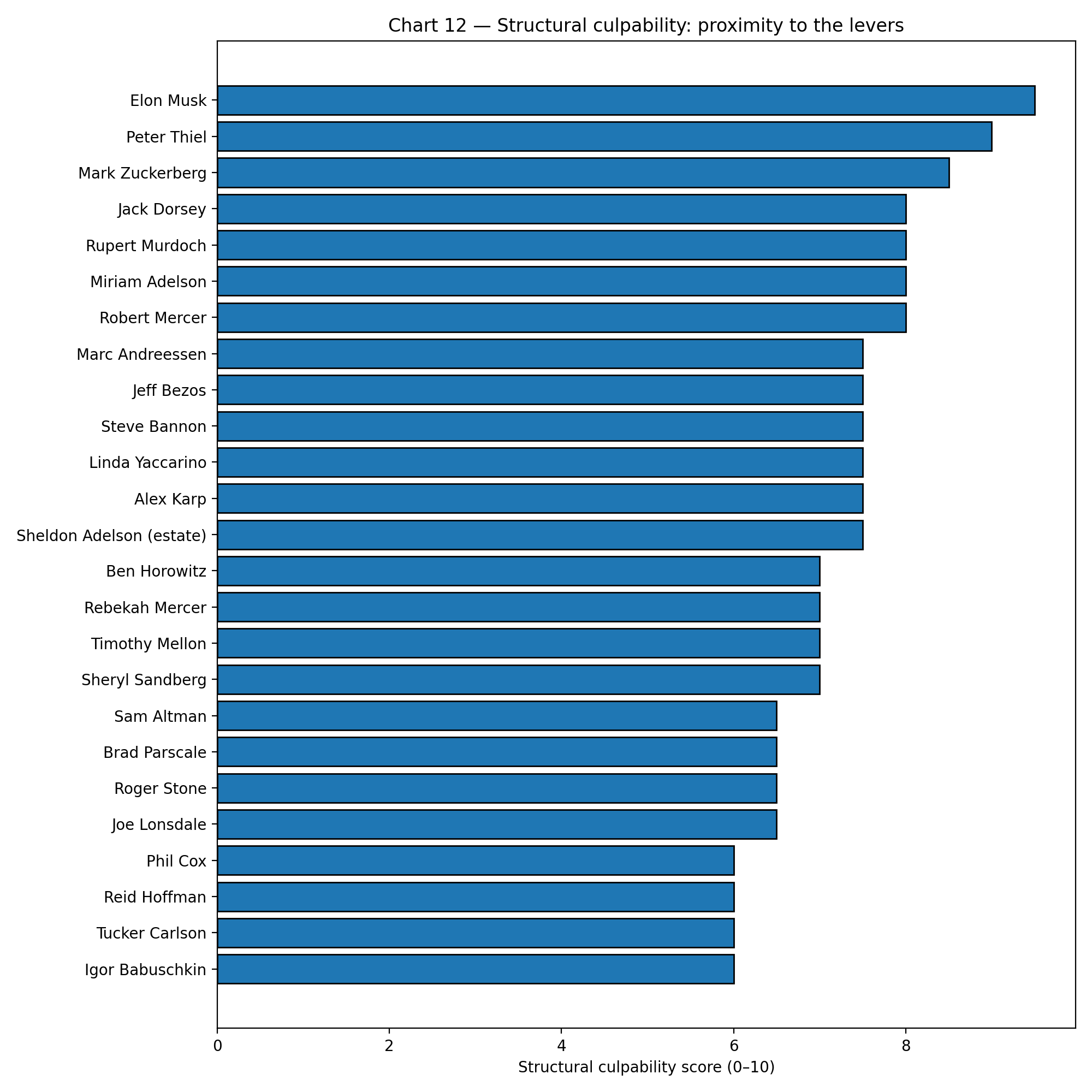
This chart ranks individuals by structural responsibility, not guilt, intent, or coordination. (We’ve added more detail at the end)
The bars represent:
Control over systems (platforms, money, data, velocity)
Ability to outlast attention cycles
Distance from consequence
Higher score ≠ evil
Higher score = more leverage over outcomes
Imagine a game where some people get to decide:
how fast the clock runs
who gets extra time
and who has to stop playing early
This chart shows who controls the clock — not who broke the rules.
Accountability fails not because of villains in rooms, but because power is concentrated in people who can wait longer than attention lasts.
XII. What Breaks the Loop
If the failure were misinformation alone, fact-checks would suffice. If it were coordination alone, enforcement would end it. The breakdown here is temporal. Accountability requires persistence, and the current system systematically deprioritizes it.
Breaking the loop would require restoring conditions that allow attention to accumulate rather than evaporate: friction against pure velocity, transparency in how narratives are routed, and standards that privilege continuity over motion. These are not radical interventions. They are simply incompatible with systems optimized exclusively for engagement.
XIII. The Accountability Standard
This work does not ask to be believed. It asks to be inspected.
Every claim presented here is anchored to a metric, an exhibit, or a logged evidentiary artifact. Where certainty ends, it is labeled. Where interpretation begins, it is marked. No assertion relies on anonymous sourcing or untraceable inference.
That is the accountability standard this system now requires—not louder claims, but verifiable ones.
XIV. Close
The most dangerous feature of the modern information environment is not that false stories spread. It is that true ones can arrive, be seen by millions, and still fail to matter.
Nothing ever happens not because nothing is real, but because endurance has been engineered out of the process. Attention rises faster than institutions can respond, collapses before verification can harden into consequence, and then moves on.
This is not a failure of the public. It is not proof of apathy or ignorance. It is the predictable outcome of systems that reward speed over continuity and motion over resolution.
Accountability has not vanished. It has been outrun.
And THAT ladies and gentlemen is how we’re being controlled. There is no accountability any more because the internet is moving faster than reality and they’ve rewired our minds to let it go. And the engine of it all…is X.
Now here’s the problem. We know everyone on the left reading this will be skeptical, because it does sound like a far-fetched conspiracy. Everyone on the right (MAGA) will attempt discrediting it. We thought of that. Below are 18 questions we’ve “mocked up” with real answers. 9 for each side. And then a BOMBSHELL at the bottom.
SKEPTICAL RIGHT QUESTIONS
1. “Isn’t this just another conspiracy theory with fancy charts?”
Answer:
No—conspiracies rely on secrecy; this system works in public by conditioning attention, shortening memory, and rewarding emotional reflex over comprehension.
2. “Are you saying Trump supporters are being controlled?”
Answer:
Not controlled—neurologically rewired by an environment that trains everyone to react fast, forget faster, and confuse repetition with truth.
3. “So you think conservatives are stupid?”
Answer:
No—this system works precisely because it exploits normal human cognition under speed, stress, and constant stimulation, regardless of intelligence.
4. “Why don’t people just think for themselves?”
Answer:
Because the feed punishes sustained thinking by burying anything that doesn’t generate immediate emotional motion.
5. “Isn’t this just free speech you don’t like?”
Answer:
Free speech doesn’t require algorithmic amplification that systematically privileges outrage over evidence and speed over understanding.
6. “Why didn’t this affect the left the same way?”
Answer:
It did—the difference is narrative direction, for the left they’ve been conditioned to accept that resistance is futile and accountability will never come. We just wrote a study on it called NOTHING WILL HAPPEN / NOTHING EVER HAPPENS. For the right, they’ve been indoctrinated with racism, religious virtuosity, homophobia, xenophobia, WOKE hate, etc.
7. “If this is real, why hasn’t it collapsed already?”
Answer:
Because systems that monetize attention don’t collapse when exposed—they collapse only when attention patterns change.
8. “Where’s the proof people are actually being affected?”
Answer:
The proof is behavioral: shortened attention spans, collapsing persistence, and the repeated inability of millions to hold focus long enough for accountability.
9. “So who’s actually benefiting from this?”
Answer:
Those with money, infrastructure, and time—because delay is lethal to public pressure but harmless to power.
SKEPTICAL LEFT QUESTIONS
1. “How do we know this isn’t just correlation?”
Answer:
Because independent models—network theory, probability analysis, and behavioral burst data—converge on the same nodes and outcomes.
2. “What’s the psychological mechanism here?”
Answer:
The system trains users to prioritize novelty and outrage, degrading working memory and making sustained attention neurologically expensive.
3. “Are you claiming mass brainwashing?”
Answer:
No—mass conditioning, where incentives reshape behavior without needing belief or obedience.
4. “How does this affect belief formation?”
Answer:
Repeated exposure plus rapid decay replaces evidence-based reasoning with familiarity-based confidence.
5. “Why do accurate, well-documented stories still fail to produce accountability?”
Answer:
Because accountability requires sustained attention, and the system is optimized to collapse attention before verification can harden into consequence.
6. “Is this unique to MAGA or the right?”
Answer:
No—the left has been conditioned to mistake moral signaling for structural change and to confuse visibility with progress.
7. “What’s the strongest evidence this alters behavior?”
Answer:
Because it leaves a behavioral scar: shortened focus, constant agitation, learned helplessness, and a population that sees the truth, feels overwhelmed, and then shuts down—textbook conditioning, not persuasion.
8. “What would a healthy information system look like by contrast?”
Answer:
One where stories plateau, not spike; where verification outperforms velocity; and where attention can accumulate instead of evaporate.
9. “Why hasn’t regulation fixed this?”
Answer:
Because regulation lags systems that operate faster than institutions can react—and delay is profitable.
We are not accusing anyone of anything, but these are the people we’d recommend an investigative journalist look into:
The 25 Most Structurally Responsible People
(STRUCTURAL RESPONSIBILITY INDEX ABOVE)
The Machine: Power, Money, and Control Surfaces
PLATFORM OWNERSHIP & CORE ARCHITECTURE
(These people matter most. They define the environment.)
1. Elon Musk — 9.5 / 10
Why: Owner of X; final authority over ranking, enforcement, monetization, product direction, and tolerance of amplification dynamics.
2. Jack Dorsey — 8.0 / 10
Why: Designed the original engagement-first architecture that structurally persists regardless of ownership.
3. Linda Yaccarino — 7.5 / 10
Why: CEO operationalizing monetization, incentives, and partnerships that directly shape what the feed rewards.
4. Mark Zuckerberg — 8.5 / 10
Why: Built the largest attention-optimization system on earth; normalized algorithmic amplification as governance.
5. Sheryl Sandberg — 7.0 / 10
Why: Scaled engagement-based monetization and growth logic that spread across platforms industry-wide.
DATA, AI, & BEHAVIORAL INFRASTRUCTURE
(They made attention measurable and targetable.)
6. Peter Thiel — 9.0 / 10
Why: Normalized large-scale behavioral data modeling for political and state use; bridged tech, ideology, and capital.
7. Alex Karp — 7.5 / 10
Why: Operationalized Palantir’s analytics systems that institutionalized behavioral prediction and control.
8. Joe Lonsdale — 6.5 / 10
Why: Extended Palantir-era logic into political, academic, and policy ecosystems.
9. Igor Babuschkin — 6.0 / 10
Why: Senior ML engineer in Musk ecosystem; helps translate AI systems into platform behavior shaping.
10. Sam Altman — 6.5 / 10
Why: AI scaling decisions accelerate content velocity, synthetic engagement, and attention saturation.
CAPITAL & VENTURE POWER
(They don’t post — they decide what survives.)
11. Marc Andreessen — 7.5 / 10
Why: Venture capital influence shaping platform governance norms and political alignment of tech.
12. Ben Horowitz — 7.0 / 10
Why: Co-shapes the ideology of “move fast, break norms” now embedded in civic infrastructure.
13. Jeff Bezos — 7.5 / 10
Why: Owns both a platform (Amazon) and a media institution; shapes attention economics at scale.
14. Reid Hoffman — 6.0 / 10
Why: Demonstrates this system is bipartisan; funds and legitimizes platform-centric political influence.
POLITICAL MEGADONORS & DARK-MONEY AMPLIFIERS
(They finance endurance and delay.)
15. Miriam Adelson — 8.0 / 10
Why: Sustained, massive funding that allows political actors to outlast attention cycles.
16. Sheldon Adelson (estate) — 7.5 / 10
Why: Structural continuation of funding networks shaping modern right-wing media ecosystems.
17. Timothy Mellon — 7.0 / 10
Why: Repeated Super PAC funding that enables narrative churn without accountability pressure.
18. Robert Mercer — 8.0 / 10
Why: Early financier of algorithmic political warfare and psychographic targeting.
19. Rebekah Mercer — 7.0 / 10
Why: Operationalized Mercer-funded data and media strategies into real-world politics.
AMPLIFICATION & NARRATIVE STRATEGY
(They normalized velocity as power.)
20. Steve Bannon — 7.5 / 10
Why: Articulated “flood the zone” logic that the feed now automates mechanically.
21. Roger Stone — 6.5 / 10
Why: Early adopter of chaos-as-strategy in modern political media.
22. Tucker Carlson — 6.0 / 10
Why: Popularized outrage-as-distribution and grievance monetization across platforms.
23. Rupert Murdoch — 8.0 / 10
Why: Decades-long normalization of outrage-driven media economics that platforms later digitized.
SYSTEM OPERATORS & POLITICAL ENGINEERS
(They connect money, data, and turnout.)
24. Brad Parscale — 6.5 / 10
Why: Demonstrated how digital targeting and micro-messaging could dominate modern campaigns.
25. Phil Cox — 6.0 / 10
Why: Converts donor capital into turnout and persistence machinery.
Where Trump Fits (for context)
Donald Trump — 4.5 / 10
Why: Not an architect or owner; a highly successful adapter and beneficiary of the system once it existed.
What Trump likely did and did not know
What he almost certainly did not know
He did not architect algorithmic ranking systems.
He did not design attention-economy incentives.
He did not build data-targeting infrastructure.
He did not invent “flood-the-zone” mechanics at the platform level.
Those levers pre-existed him and were built by tech, capital, and media actors long before he entered politics.
What he almost certainly did know
That outrage outperformed truth on the feed.
That velocity mattered more than verification.
That attention could be redirected faster than it could be resolved.
That delay was safer than accountability.
You can see this in behavior, not speculation:
Constant narrative churn
Replacement scandals
Attacks on institutions timed to attention spikes
Reliance on amplification hubs rather than direct explanation
This is adaptation, not authorship.
The Jaw-Dropper
None of these people needed to coordinate.
They only needed to build, fund, and normalize systems that reward speed, outrage, and forgetting — and those systems now govern everyone while simultaneously shielding anyone from accountability. When Steve Bannon said he was going to “flood the zone” he was talking about the never-ending rapid news cycle and how that strategy allows the evasion of culpability.That’s the evil hiding in plain sight:
No villains in rooms
No secret meetings required
Just powerful people designing systems where accountability reliably dies
Our whistleblower Kory Amyx brought (a form of) this to all of the major intelligence agencies. Repeatedly. He had every piece of evidence he ever needed.
They refused to follow up.
Final Recap
The Simple Explainer
In the past, news moved slower.
Stories stayed visible for days or weeks.
Editors decided what stayed in the spotlight.
That time allowed facts to be checked, pressure to build, and institutions to respond.
Today, that middle phase is gone.
Stories now move through systems that reward speed, not completion.
Attention spikes fast.
Then it collapses just as fast.
Before anything can finish, something new replaces it.
Nothing has time to settle.
Why That Matters
Accountability takes time.
Investigations take time.
Rebuttals take time.
Consequences take time.
When attention disappears in days instead of weeks, power doesn’t need to deny anything.
It just needs to wait.
And waiting works — because the system keeps moving on.
How Attention Actually Moves Now
Attention doesn’t spread evenly.
It travels through corridors — a small number of highly connected accounts that sit between large groups of people.
These accounts don’t need to invent stories.
They don’t need to coordinate secretly.
Their position alone lets them decide what moves next and what gets replaced.
When one story slows down, something else speeds up — and attention follows.
This happens again and again, across completely different topics.
Different stories.
Same outcome.
Why This Isn’t Random
When you look at the data closely, most people behave normally.
They post occasionally.
They engage at regular rates.
They react when something matters.
But a very small number of accounts behave very differently.
They post at extreme speeds.
They show up repeatedly at key moments.
They land again and again in statistically unlikely patterns.
This doesn’t prove a conspiracy.
It proves structure.
When the same accounts stand out across different methods, different stories, and different time periods, coincidence becomes less likely.
What This Does to People
Living inside this system changes how people think and feel.
When you see important stories appear and disappear over and over, you learn something:
Waiting doesn’t work.
Over time, people stop expecting outcomes.
They still react — but they stop hoping.
Engagement becomes performance instead of pressure.
This isn’t apathy.
It’s adaptation.
And the stress of constant urgency without resolution takes a toll — on focus, on sleep, on mental health.
A system that never lets attention rest also never lets people rest.
Where Money Fits In
This system doesn’t exist in a vacuum.
Large political and financial actors operate on a completely different time scale.
They can afford delay.
They can wait out outrage.
They can absorb scrutiny until attention fades.
When public focus collapses quickly, delay becomes a winning strategy.
No cover-up is required.
No coordination is required.
Time itself does the work.
The Core Insight
Nothing “ever happens” not because nothing is real —
but because endurance has been engineered out of the process.
Attention moves faster than reality can respond.
Truth can surface.
It can trend.
It can be seen by millions.
And still fail to matter.
The Most Important Thing to Understand
This is not about villains in rooms.
It’s not about secret meetings.
It’s not about controlling what people think.
It’s about systems that reward speed over continuity.
When speed wins, accountability loses — every time.
In One Sentence
This is why nothing ever happens: the richest people on the planet created an information system that allows exposure without consequence, ensuring they will never experience accountability — and teaching the rest of us to give up on justice.
That’s the machine.