
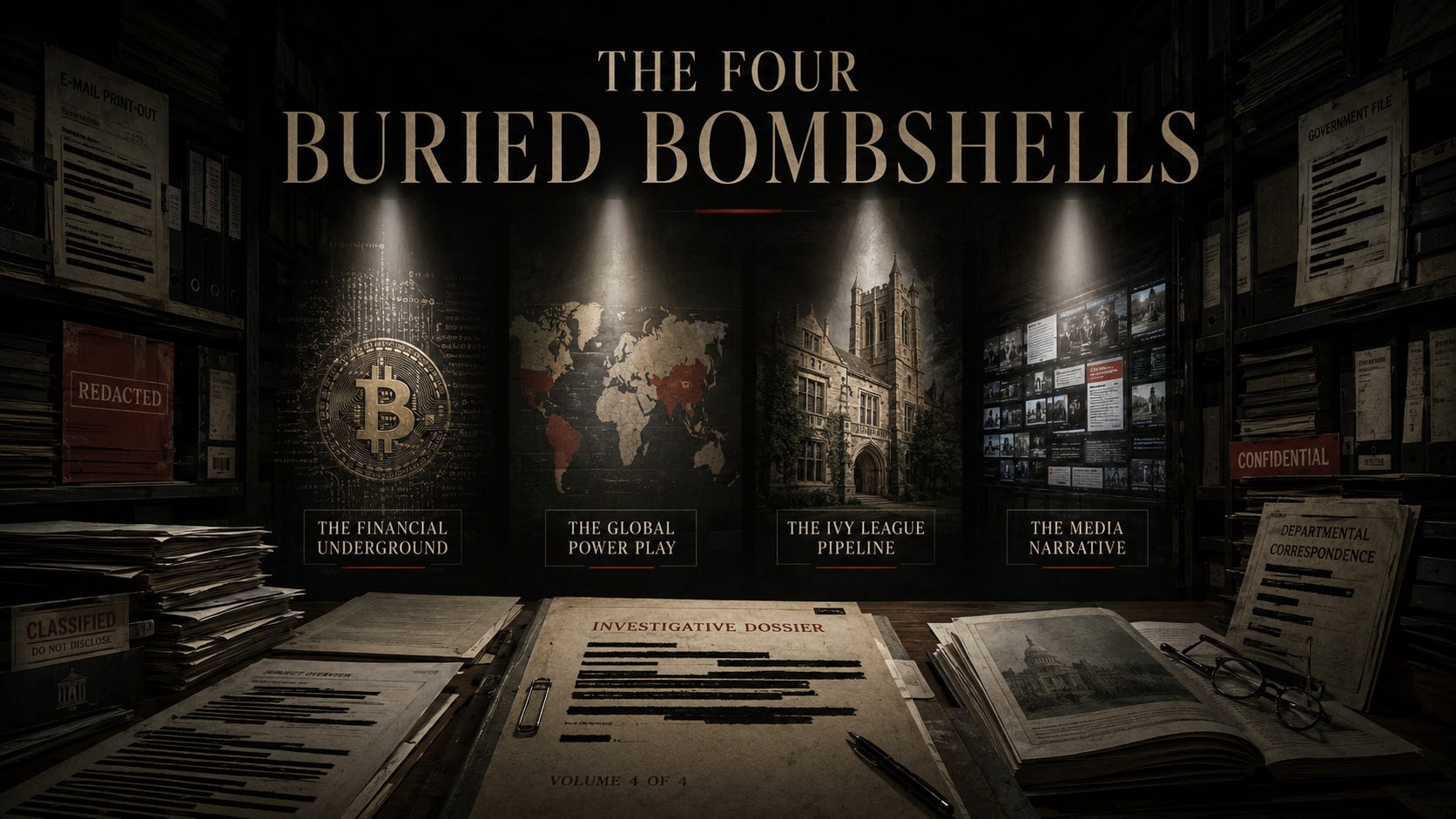
THE FOUR BURIED BOMBSHELLS
What the headlines captured, what they left scattered across millions of records—and what emerges only when the pieces are assembled

The Epstein Files’ Four Buried Bombshells
By MAGA Cult Slayer
Editor’s note: This investigation distinguishes between what the released records document, what they strongly suggest, and what remains unproven. Appearing in Jeffrey Epstein’s correspondence does not establish criminal conduct. The questions raised here concern documented communications, institutional behavior, political strategy and the incomplete public accounting of what followed.
The problem with the Epstein files was never simply that there were too few documents.
The problem was that there were too many.
Millions of pages arrived in waves: emails, calendars, photographs, interview summaries, property records, flight materials, legal documents and duplicate productions under different numbering systems. The public was handed an ocean and told that transparency had been achieved because the water was technically visible.
That is not how investigative journalism works.
An enormous document release can conceal almost as effectively as a locked file cabinet when nobody is assigned to reconstruct the systems hidden across it. One newsroom finds an embarrassing email. Another identifies a famous name. A television segment spends four minutes on an offensive remark. A newspaper publishes a searchable list of who appeared where. Each fragment may be accurate. Yet the architecture disappears.
And architecture is what matters here.
Jeffrey Epstein did not survive after his 2008 conviction merely because powerful people kept answering his calls. He survived because he remained useful. The records increasingly portray a man who could connect money to politics, politics to media, media to elite institutions, and elite institutions back to reputation and legitimacy. He offered access, introductions, strategic advice, financial imagination and a private clearinghouse where people from worlds that supposedly hated one another could quietly meet.
Major outlets have reported pieces of this. The Guardian has documented Epstein’s extraordinary role advising Steve Bannon on media messaging, helping Bannon think through European nationalist politics and participating in an attempted rehabilitation project that included a filmed interview with Epstein. Forbes has reported on Epstein’s effort to manipulate Google results and bury his criminal history beneath favorable material about science, philanthropy and technology.
But the most important stories do not sit inside those individual discoveries.
They appear when the fragments are cross-woven.
What follows are four bombshells buried in that architecture.
I. The Crypto Political-Finance Blueprint
The first bombshell begins with a question that should make every campaign-finance lawyer, election-security reporter and congressional investigator stop what they are doing:
Why were Jeffrey Epstein and Steve Bannon discussing how cryptocurrency might finance political activity while navigating foreign-donor restrictions and the rules governing campaigns?
The released correspondence shows something far more consequential than two wealthy men chatting about Bitcoin.
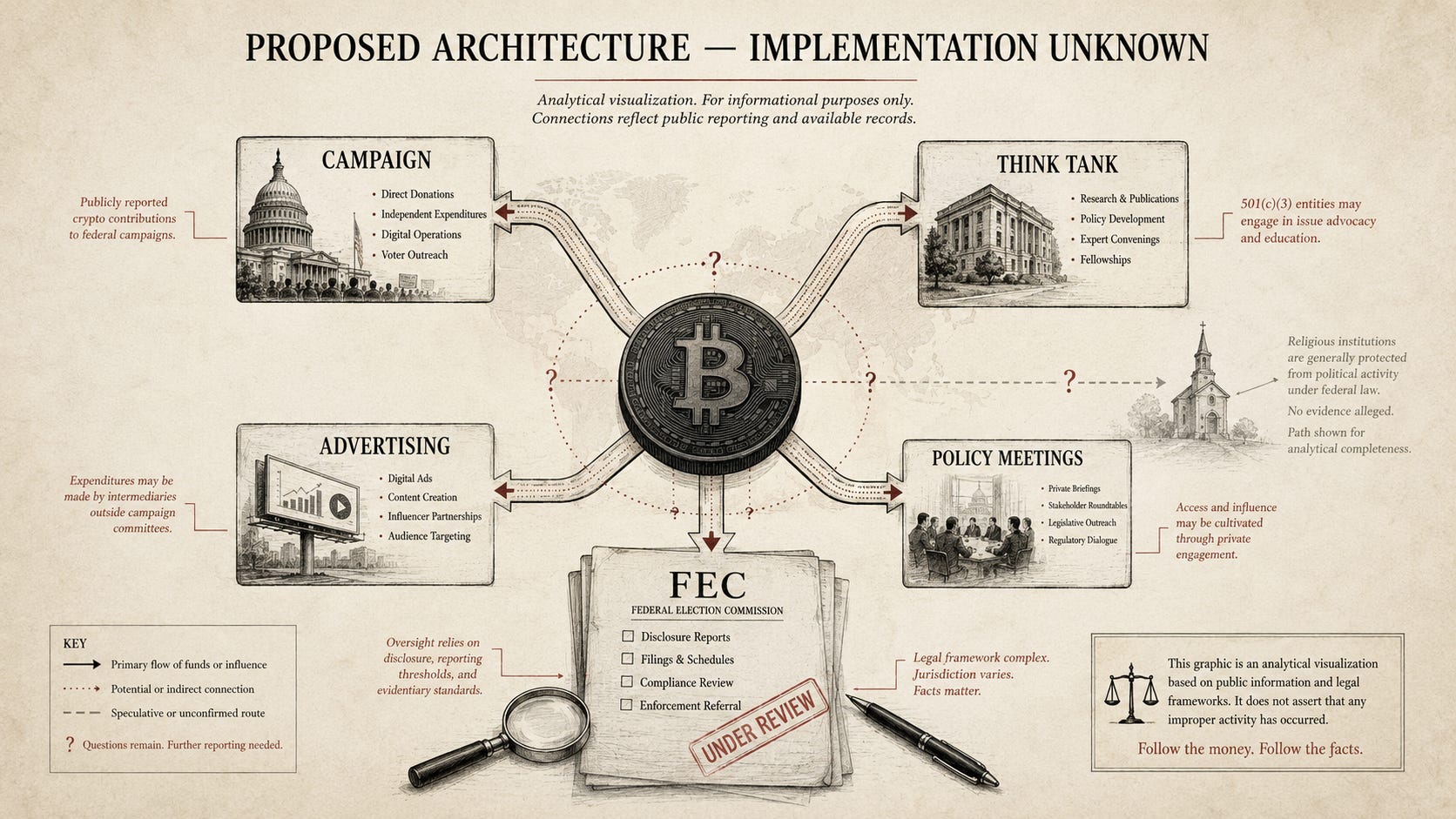
In the exchange, Epstein explored a structure involving the receipt, distribution and payment of cryptocurrency. He described a possible “coin cooperative.” He asked about prohibitions involving foreign donors. He wanted to know whether money would have to pass through a political campaign at all, or whether it could instead support a think tank, advertising, policy meetings or related coalition activity.
Those are not abstract questions about blockchain technology.
They are questions about political-finance architecture.
Bannon did not dismiss the exercise. He replied that he was working on it. The discussion then widened. Epstein asked about specialists in federal election law. He raised possible religious components, including a church and a tithe. He referenced access to people in Brock Pierce’s cryptocurrency orbit and another figure described as capable of walking them through “the deal.” The political objective was articulated as a coalition led first by populists and nationalists, followed by conservative Christians.
One message described the coalition as a mechanism capable of holding off the cultural and political forces represented by the #MeToo era for another decade.
That is the part that cannot be reduced to “Epstein knew Bannon.”
The records show a convicted sex offender, one of the most internationally connected private financiers of his era, brainstorming with a former White House chief strategist about a financing and organizational system for a political movement. The conversation touched cryptocurrency, donor restrictions, campaign routing, think tanks, advertising, religious constituencies and legal expertise.
It is essential to state what the documents do not establish. They do not prove that such a system was ultimately launched. They do not prove that foreign money entered an American campaign. They do not prove that a church was created as a laundering vehicle or that any specific person committed a campaign-finance crime.
But journalism does not require proof that a proposed operation succeeded before investigating why it was proposed, who participated and what came next.
The questions are obvious.
What was the contemplated cooperative? Who were the unnamed Swiss participants? Which election-law specialist was consulted? What role, if any, did figures in Pierce’s cryptocurrency network play? Were any related nonprofits, churches, think tanks, political committees, token projects or donor vehicles subsequently created? Did any money move? Did Bannon’s European political operation adopt any parallel structure?
The Guardian has reported that Bannon sought Epstein’s support while attempting to strengthen nationalist and Eurosceptic parties across Europe, including movements associated with Matteo Salvini, Marine Le Pen and Germany’s AfD. The reporting found no evidence that Epstein ultimately funded those parties, but it did establish that Epstein’s network was being courted as Bannon tried to create a transnational political alliance.
That reporting makes the crypto correspondence more important, not less.
Because now the funding discussion has a political destination.
The bombshell is not that Epstein and Bannon committed a proven crypto crime. The bombshell is that the released records show them contemplating an alternative political-finance machine at the same time Bannon was constructing an international nationalist movement—and there has been no adequate public accounting of whether any element of that architecture was implemented.
Why this was missed
The media covered Bannon’s relationship with Epstein as hypocrisy: the populist warrior against global elites quietly consorting with one of the most notorious elite predators on Earth.
That is a powerful story. It is also the smaller story.
The larger story is operational. Epstein was not merely socializing with Bannon. He was helping think through money, law, constituency structure, media and international expansion. When those conversations are reported separately, they look eccentric. When placed together, they resemble strategic planning.
That is the bombshell.
II. The Network Handoff
The second bombshell is larger than any individual financial proposal.
It concerns what Epstein may have been giving Bannon that few other people could provide: a map into the private rooms of international power.
The released messages show Epstein telling Bannon that he could arrange one-on-one meetings with numerous national leaders. But the most revealing part was not the offer itself. It was the advice that accompanied it.
Epstein told Bannon that he needed to remain in these places long enough to become an insider rather than an outsider who simply flew in and out.
That is not the language of a casual introduction.
It is the language of political cultivation.
Epstein appears to have been coaching Bannon on how elite international networks actually absorb a person: not through one dramatic meeting, but through repeated presence, private conversation, social normalization and sustained access. This was expertise Epstein possessed in abundance. For decades, he moved through universities, royal households, philanthropic organizations, financial firms, scientific institutes and political circles with no official position that adequately explained his reach.
He was a private switchboard.
Bannon, meanwhile, was attempting to transform himself from a former White House strategist into the intellectual and logistical center of a global nationalist revolt. He needed donors, leaders, filmmakers, intermediaries, diplomats and institutions. Epstein could not publicly bless such a movement. He could do something more valuable: make introductions while remaining invisible.
The records also contain a sprawling item described as a list for Bannon—an apparent inventory of influential people spanning politics, finance, academia, science, technology, media, diplomacy and international society.
The exact purpose of that list has not been definitively established. It may have been assembled for interviews, introductions, documentary projects, political outreach or some combination of those. A responsible investigation should not pretend certainty where the documents do not provide it.
But context matters.
A broad elite-contact list becomes more significant when the person providing it has also offered meetings with heads of government, advised the recipient to cultivate insider status and participated in the recipient’s international political project.
At that point, the central question is no longer whether Epstein and Bannon were friends.
It is whether an elite network accumulated by Epstein over decades was being partially transferred, repurposed or made available to Bannon.
The Guardian’s reporting has already established that Epstein advised Bannon’s messaging in real time, helped shape his television appearances, discussed Bannon’s films and engaged deeply with his European political ambitions. The same reporting shows Bannon later helping Epstein with reputation management and participating in a documentary-style interview that could have served Epstein’s attempted rehabilitation.
That relationship was reciprocal.
Bannon received access, strategic conversation and international networking capacity. Epstein received political intelligence, media coaching and a potential route toward public rehabilitation.
That is not merely friendship.
It is an exchange of capabilities.
Why this was missed
Most coverage remains organized around individual reputations. Did Bannon behave hypocritically? Did a European leader meet him? Did Epstein know a billionaire, professor or politician?
The corpus demands a more systemic question:
What could Epstein’s network do?
A list of names is gossip. A network with a purpose is infrastructure.
Epstein’s enduring power may not have been that he possessed a single explosive secret about every person he knew. It may have been that he understood who needed money, who needed legitimacy, who wanted access, who needed favorable media, who could provide scientific prestige, and who could connect one silo of power to another.
He was valuable because he reduced the distance between worlds.
The bombshell is that Bannon’s nationalist project appears to have intersected with that private switchboard at precisely the moment Bannon was attempting to scale internationally.

III. The Institutional Reputation-Laundering Machine
The third bombshell concerns how a convicted predator rebuilt social legitimacy in plain sight.
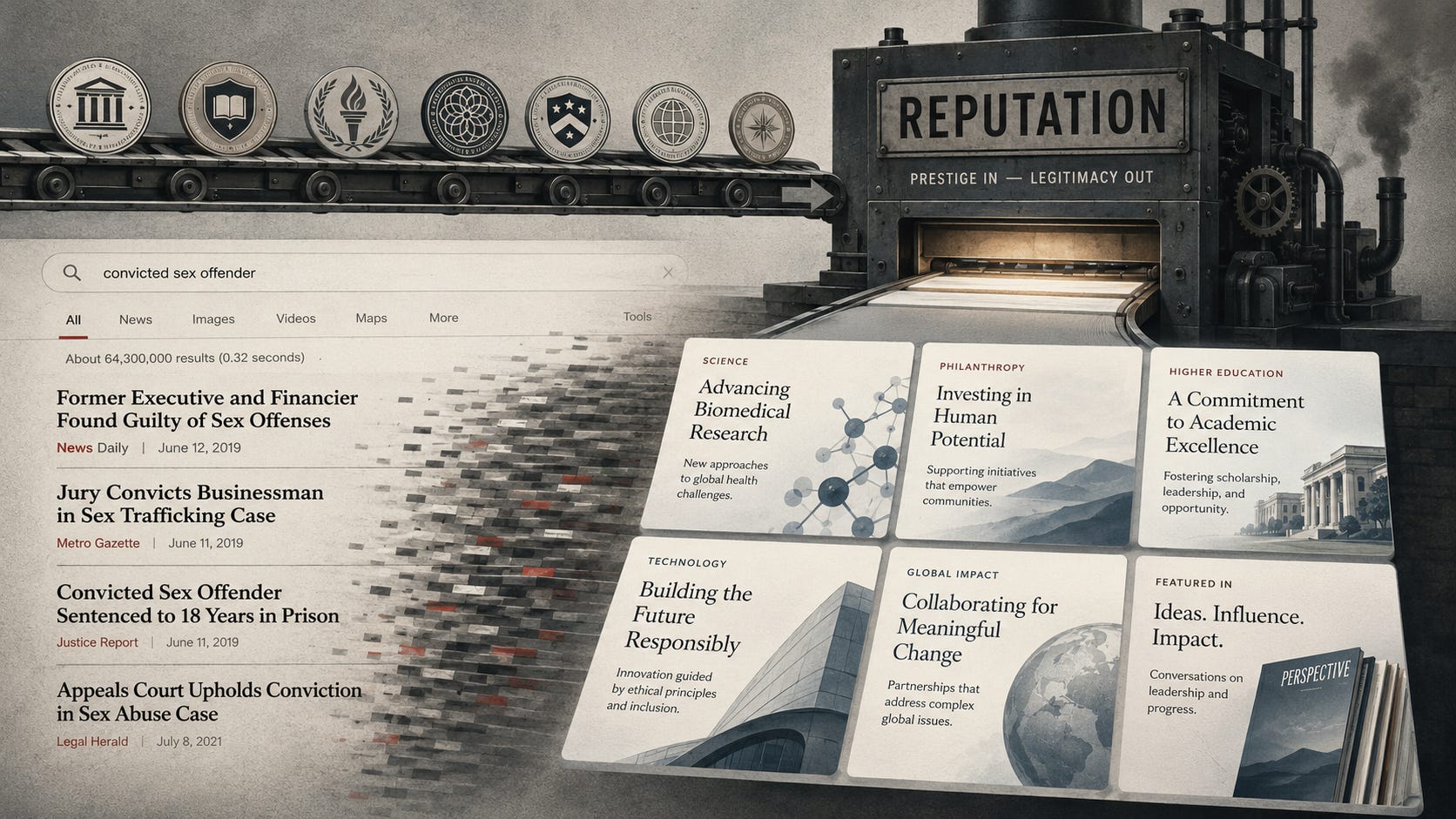
Forbes has reported that Epstein employed search specialists and people with hacking backgrounds to manipulate his online reputation after his conviction. The strategy involved promoting stories about philanthropy, science and technology so that reporting on his sex crimes would sink beneath favorable content in Google results.
But calling this “SEO” makes it sound smaller and more technical than it was.
The deeper operation appears to have relied on institutional authority as raw material.
Epstein did not merely need websites saying he was generous. He needed respected institutions to produce authentic-looking signals of legitimacy: university pages, science initiatives, foundation announcements, magazine articles, conference appearances, favorable profiles and philanthropic partnerships. Those assets could then be amplified by search manipulation until a person researching Epstein encountered an alternate biography.
The correspondence discussed strategies involving favorable publication, multiple interconnected websites and high-authority domains. It referenced Harvard, National Geographic and other publications or institutions whose reputational weight could overpower ordinary websites in search results.
This was not simply hiding bad news.
It was manufacturing a replacement identity.
The old identity was convicted sex offender.
The new identity was visionary patron of science, technology, mathematics, artificial intelligence and global intellectual life.
That transformation required more than a publicist. It required a supply chain.
Academics accepted funding. Institutions hosted initiatives. journalists wrote profiles. Foundations issued announcements. Scientists appeared in photographs. Conferences offered proximity to respected people. Technologists engaged with Epstein as though his curiosity itself conferred legitimacy.
Some participants may have been deceived. Some may have rationalized the relationship as a necessary compromise to obtain funding. Some may have believed that the conviction belonged to the past. Others may have known far more than they have admitted.
Those distinctions matter, and they must be investigated individually.
But the system-level result is already visible.
Institutional prestige was converted into searchable evidence of virtue.
Once enough of that evidence existed, technical specialists could promote it, interlink it and use it to push reports about victims lower in search results. The ethical failure was therefore not confined to whoever manipulated the algorithm. The algorithm could only amplify the legitimacy that elite institutions had already supplied.
That is why this story is bigger than Google.
It is about the laundering of moral status through universities, philanthropy, science and journalism.
Forbes has also reported on figures who helped Epstein gain access to technology founders and journalists while assisting his reputation efforts. Those relationships show that rehabilitation and network expansion were not separate projects. Improving Epstein’s image created new access; new access generated additional prestigious associations; those associations then produced more material to improve the image.
It was a self-reinforcing loop.
Prestige created search results.
Search results created legitimacy.
Legitimacy created access.
Access created more prestige.
Why this was missed
News coverage often asks which famous people remained friends with Epstein.
The more important question is which institutions produced the content that made continued friendship socially defensible.
When Harvard, a respected scientific initiative or a major publication appeared beside Epstein’s name, it did not merely flatter him. It gave every subsequent associate a rationalization: serious people still deal with him; therefore dealing with him must be acceptable.
That is how normalization works.
Not through a grand secret meeting, but through accumulated signals that tell people the danger has passed.
The bombshell is that Epstein’s rehabilitation operation appears to have used institutional credibility as an engineered input—and the public has never received a complete accounting of which institutions knew they were participating in that process.
IV. The Private Influence Machine Hidden in Plain Sight
The fourth bombshell is the synthesis.
It is what happens when the political-finance discussions, international network cultivation and reputation-laundering operation are viewed as parts of the same organism.
Epstein’s post-conviction role increasingly appears to have been that of a private cross-domain broker.
He could connect:
financial capital to political projects;
political figures to international leaders;
controversial people to elite institutions;
media strategy to reputation repair;
technologists to donors;
academics to wealthy patrons;
public messaging to private access.
Each relationship gave him information and leverage. Each introduction increased his usefulness. Each institutional association helped normalize the next one.
The conventional picture of Epstein is vertical. At the top sits a wealthy predator. Beneath him are victims, assistants and powerful acquaintances.
The documents suggest a horizontal structure as well.
Epstein sat between systems.
He occupied the seams connecting government, finance, science, technology, intelligence-adjacent circles, philanthropy, media and international politics. That position may explain why so many powerful people continued to engage him after his conviction. They were not necessarily attracted to the same thing. One sought money. Another wanted a meeting. Another wanted advice. Another wanted access to a scientist. Another wanted help with a woman. Another wanted media strategy. Another wanted political intelligence.
Epstein did not need every associate to participate in one unified conspiracy.
He only needed each person to use one service.
That is the more credible and more disturbing model.
It does not require a cinematic control room. It requires a broker who collects needs, matches them to resources and remembers what everyone asked for.
The records surrounding Little Saint James offer a physical metaphor for the same system. The island’s own operational documents show that the property was not a mysterious blank space but a heavily managed compound with docks, communications, emergency systems, service gates, surveillance, roads, engineering spaces, construction projects and a formally maintained structure called the LSJ Tunnel. The punch lists identify a tunnel roof, entrance, gate and repairs, while island staff were instructed to photograph projects from beginning to end.
Those records do not establish that the tunnel was used for trafficking or any other crime. They do establish something methodologically important: the public mythology surrounding Epstein often distracts from the documented administrative reality.
His world ran on lists.
Punch lists.
Contact lists.
Schedules.
Introductions.
Google-result plans.
Media plans.
Political plans.
Funding questions.
Project photographs.
Travel arrangements.
The machine was mundane enough to be missed.
That may be why it survived.
Why this was missed
Mainstream reporting is optimized for discrete revelations. A powerful person resigns. A celebrity appears in an email. A politician is embarrassed. An institution begins a review. A scandal is assigned a name and a news cycle.
Systems are harder.
They require reporters to read beyond their beats. The political desk must understand cryptocurrency. The technology desk must understand campaign finance. The education desk must understand reputation laundering. The foreign desk must understand Bannon’s nationalist project. The investigative desk must connect all of them.
Without that integration, the public receives a series of morally shocking anecdotes but no explanation for how Epstein remained operational.
The fourth bombshell is therefore the simplest:
The Epstein files are not merely a contact book of compromised elites. They are the partial operating record of a private influence machine.
Its product was access.
Its currency was usefulness.
Its shield was prestige.
And its survival depended on every institution seeing only the small service it received, rather than the larger system it was helping sustain.
What Has Been Reported—and What Still Has Not Been Answered
To say these stories were missed does not mean no journalist has touched them.
The Guardian has done important work documenting Epstein’s strategic relationship with Bannon, Bannon’s European political ambitions and their mutual reputation-management efforts. Forbes has exposed elements of Epstein’s search manipulation and his use of publicists and technology contacts. Other outlets have documented consequences for prominent individuals and institutions whose relationships with Epstein continued long after his conviction.
The failure is not total silence.
It is fragmentation.
The unanswered questions remain enormous:
Did the crypto political-finance proposal lead to any entity, token, church, nonprofit, think tank or funding conduit?
Which international leaders did Epstein introduce to Bannon, and for what purpose?
What exactly was the intended use of the Bannon contact list?
Which institutions knowingly generated favorable content for Epstein’s rehabilitation effort?
Who approved Harvard pages, scientific affiliations, philanthropic announcements or media profiles later used to bury reporting about victims?
Did journalists or editors know they were being recruited into a search-manipulation strategy?
What records exist showing the implementation of the proposed political coalition?
Which native email attachments, photographs and source files remain missing from the flattened public release?
And perhaps most importantly:
Why did so many institutions continue to treat Epstein as a source of opportunity rather than a danger to be isolated?
The Standard of Proof
This investigation should not become what defenders of powerful people always hope it will become: a cloud of exaggerated claims that allows documented facts to be dismissed alongside speculation.
The records do not yet prove that Epstein secretly financed an election through cryptocurrency. They do not prove that every person on a contact list knowingly joined an influence operation. They do not prove that every professor, journalist or institution understood the role they played in his rehabilitation.
What they prove is sufficiently serious.
The record is already serious enough without overstating it. The correspondence shows that alternative political-finance structures were discussed while Bannon was building an international nationalist project. It shows Epstein offering access to political leaders and advising Bannon on how to become an insider rather than a visitor. It documents a coordinated effort to reshape Epstein’s online reputation by burying coverage of his crimes beneath science, philanthropy, technology and elite institutional prestige. And taken together, it reveals the central fact that should have ended his usefulness years earlier: long after his criminal conduct was publicly known, Epstein still retained value across politics, finance, media, technology, philanthropy and academia.
The proper response is not to leap beyond the evidence.
It is to demand the rest of it.
The Four Bombshells, Plainly Stated
The first is that Epstein and Bannon explored a cryptocurrency-based political-finance structure while asking questions about foreign donors, campaign routing, think tanks, advertising, religious organizations and election law.
The second is that Epstein appears to have offered Bannon not merely friendship but access to an international elite network capable of strengthening Bannon’s transnational political project.
The third is that Epstein’s reputation repair was not just search manipulation. It depended on elite institutions producing authentic-seeming evidence of respectability that could then be amplified to bury his victims’ stories.
The fourth is that these were not separate scandals. Together, they reveal Epstein’s continuing function as a private broker connecting money, politics, media, technology, institutions and international power.
That is the story the files are trying to tell.
Not that one more famous person knew Jeffrey Epstein.
But that an entire ecosystem kept finding reasons to use him.
And every time someone used him, he became harder to remove.

The public was promised the Epstein files.
What it received was a warehouse.
The work now is to build the map.
Because somewhere between the email about cryptocurrency, the invitation to meet a foreign leader, the Harvard page promoted in Google and the political strategist helping a convicted predator rebuild his image, the real story becomes visible.
Jeffrey Epstein was not simply protected by power.
For years after his conviction, he was still helping power operate.
Wow, breathless. Bombshell is the correct term. Thank you so much for this.